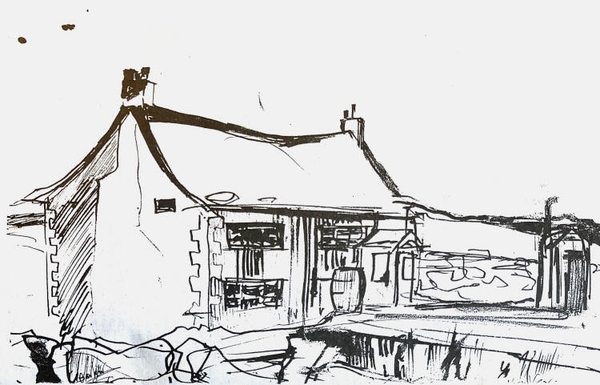
« We too had a party once at Noon Veor [1]. We may have had a windfall, or there may have been some other reason. There were quite a lot of people, certainly David and Lali, David Wright [1920-1994] and Young John, possibly John Heath-Stubbs whom I remember at the cottage on that or other occasions. He came down several times that year to join David Wright, and there was a joke about David and Heath-Stubbs crossing the dangerous streets in St. Ives. David unable to hear, Heath-Stubbs unable to see the traffic. » Kathrine Talbot [1921-2006], Barker - Cornwall 1947-1948 - Recollections of Painters and Writers.
This is the course I’ll always steer
Until the stars grow dim, sir —
That howsoever taste may veer
I’ll be in the swim, sir.
Je tiendrai toujours ce cap, Monsieur.
Où que le goût du jour puisse virer,
Je serai dans le coup, Monsieur.
Le titre d’où j’ai extrait cet épigraphe au Nouveau recueil d’oiseaux de John Heath-Stubbs est « Le poète de Bray ». L’expression anglaise vaut pour le français « girouette ». Le « Curé de Bray » fut tour à tout papiste et protestant, selon l’air du temps. Le poète de Bray décrit par Heath-Stubbs soutient donc les prolétaires dans les années trente, puis durant la guerre suit le « mouvement » romantique, et bientôt devient plus beat que les beatniks, non-conformiste jusqu’au bout des ongles, en attendant d’en être (Until, of course, I’m in it). S’entend que Heath-Stubbs moque ce personnage. Cependant, il n’aura pas cédé sur son propre non-conformisme, sans pour autant jamais arriver.
Notes
[1] « Étoile du soir », nom d’un cottage (une masure, en fait) loué par Ilse Gross Barker et Kit Barker en Cornouailles, près de St. Yves.
article précédent : Heath-Stubbs Six
article suivant : Divagation depuis Heath-Stubbs